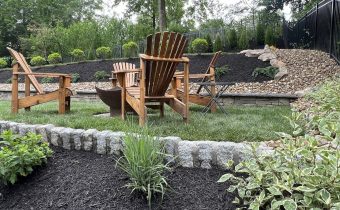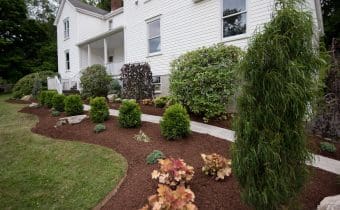
Every spring, South Hills homeowners look out at their backyards and start imagining what could be there. A patio where the family actually spends summer evenings. A retaining wall that finally solves the erosion problem on the slope behind the garage. An outdoor living area that makes the backyard feel like a real extension of the house.
The impulse is right. Outdoor living spaces add genuine value to daily quality of life and to property resale, and Pittsburgh's climate, while demanding, leaves plenty of months in a year when a well-designed outdoor space is an absolute pleasure to use. The challenge is that building those spaces in the South Hills requires navigating a set of conditions that catch a lot of homeowners off guard when they go in without good information.
Clay soils. Steep grades. Hard winters. Freeze-thaw cycles that repeat dozens of times between November and March. These aren't reasons not to build. They're reasons to build smart.
Why Pittsburgh Hardscaping Is Different from What You See Online
Houzz and Pinterest are full of stunning patio inspiration. Clean concrete pavers, minimal joints, geometric layouts, tight stone fitting. What those photos don't show is the base preparation that makes those surfaces possible, and they don't show what happens to shortcuts taken in climates that don't behave like Pittsburgh's.
Freeze-thaw movement is the defining challenge of hardscape installation in our region. Pittsburgh typically goes through 40–60 freeze-thaw cycles per winter, meaning days where temperatures cross the 32°F threshold in both directions. Every time moisture in the soil freezes, it expands. Every time it thaws, it contracts. Over one season, that repeated movement will find every weakness in a patio base, every poorly compacted section, every drainage void, and make it worse. A surface that looks fine in October can have lifted sections, cracked joints, and sunken areas by March.
South Hills clay soils intensify the problem. Clay holds water. When that water-saturated clay freezes beneath a patio, the expansion forces are significant. Without proper base depth, proper drainage, and properly graded surfaces, even quality materials will fail prematurely.
Material Selection: What Holds Up in Pittsburgh Winters
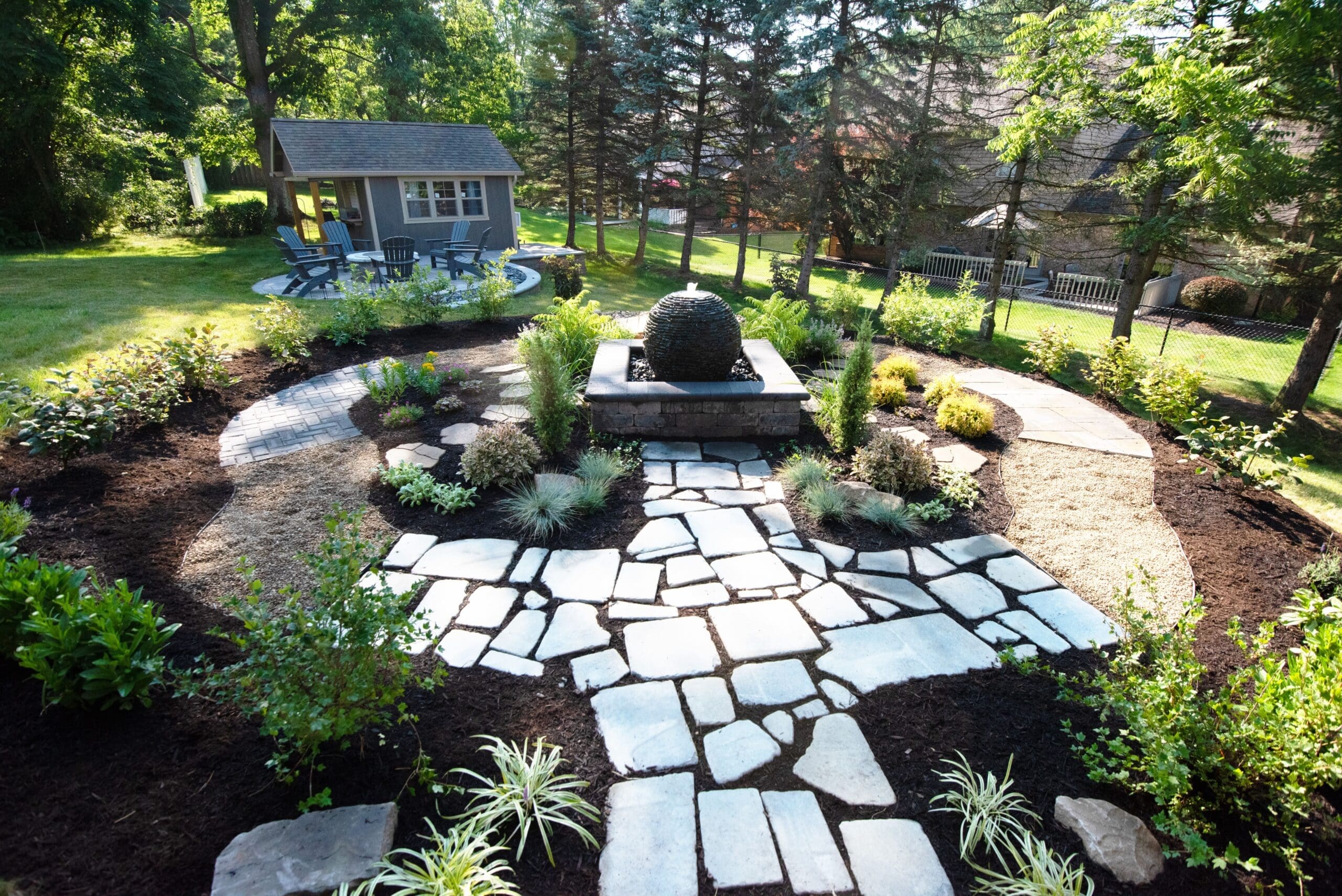 Concrete Pavers
Concrete pavers engineered specifically for freeze-thaw performance are the most practical and durable choice for most South Hills residential patios and walkways. High-density concrete pavers absorb very little water, which limits the expansion that causes cracking. The interlocking system also allows for slight individual movement without compromising the surface as a whole. That's an advantage over poured concrete, which cracks in large sections rather than shifting in small, manageable units. For most South Hills residential patios and walkways, quality concrete pavers are the most practical and durable choice.
Natural Stone
Pennsylvania bluestone and granite are the regional natural stone staples, and for good reason. Both have low water absorption rates and long track records in Pittsburgh's climate. Bluestone in particular has a regional authenticity that complements the architecture of older South Hills neighborhoods. The brick colonials and craftsman bungalows look right with natural stone in a way that some modern paver profiles don't. The trade-off is cost: natural stone runs higher than concrete pavers, and installation is more labor-intensive. For clients prioritizing aesthetics and longevity, it's often worth it.
Poured Concrete
Poured concrete patios are the least expensive hardscape option upfront, but they carry real long-term risk in Pittsburgh's climate. Concrete slabs crack, and in Pittsburgh's freeze-thaw conditions that timeline is shorter than most homeowners expect. Sealing and expansion joints help, but the material's limitations in our climate are real. We generally recommend concrete pavers or natural stone for South Hills patios where longevity is the priority.
What Makes a Retaining Wall Actually Work
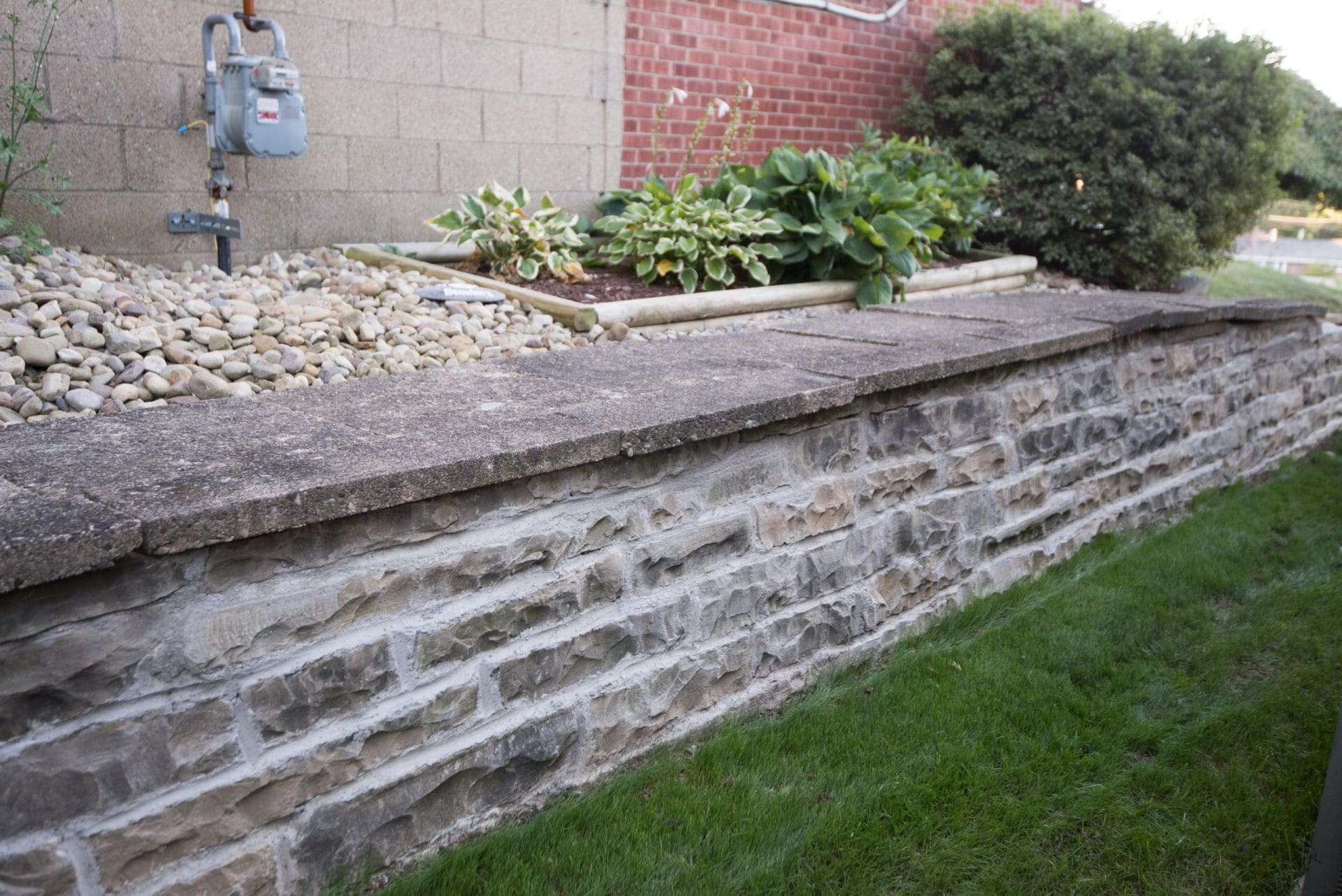 Retaining walls are one of the most requested and most misunderstood landscape features in the South Hills. Many homeowners think of them primarily as aesthetic elements, a way to create a defined planting bed or add visual structure. In reality, a retaining wall is a structural system, and building one without understanding the engineering involved leads to the most common failure mode we see: walls that look fine the first summer and begin leaning, bulging, or cracking within two to three years.
The forces at work behind a retaining wall are substantial. Soil, especially saturated clay, exerts significant lateral pressure. Add Pittsburgh's freeze-thaw cycles, and that pressure multiplies. A wall that's holding back a slope full of water-saturated clay in February is working very hard, and it needs to be built accordingly.
Drainage Is Non-Negotiable
Every structural retaining wall needs drainage behind it, full stop. Without a perforated drainpipe set in gravel backfill at the base of the wall, hydrostatic pressure builds as water saturates the soil. That pressure has nowhere to go except outward, directly into the back of the wall. Over time, even well-built walls fail under sustained hydrostatic pressure. Proper drainage redirects that water safely away from the structure.
Base Depth and Compaction
In Pittsburgh's clay soils, retaining walls require excavation well below grade, a compacted crushed stone base, and on taller sections, geogrid reinforcement that ties back into the slope behind the wall. Pennsylvania municipalities, including Mt. Lebanon, require permits and engineering for walls over three to four feet or any wall supporting a driveway or structure. The permitting process exists because undersized or improperly built walls fail, sometimes catastrophically.
Material Choices for Retaining Walls
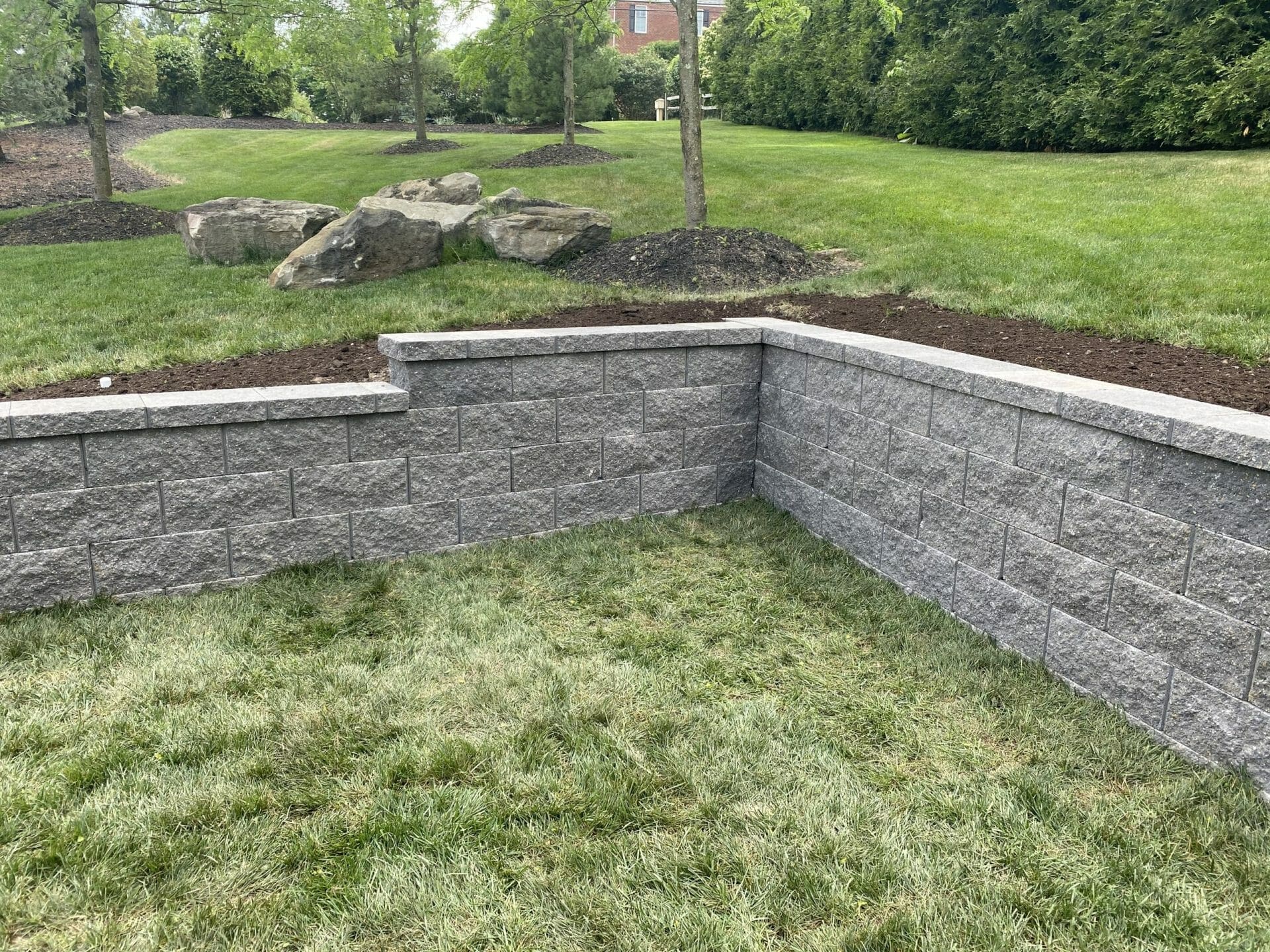
Natural stone and segmental retaining wall blocks both perform well in Pittsburgh when installed correctly. Segmental block systems are engineered for specific load-bearing capacities and come with installation specifications for base depth, geogrid placement, and batter (the slight backward lean that helps walls resist lateral pressure). Natural stone walls have aesthetic advantages, particularly on properties where the house and existing landscape have a more organic, less geometric character, which is common in older Mt. Lebanon neighborhoods.
Planning Ahead: Why Now Is the Time to Think About Next Season
Here's something most homeowners don't consider until it's too late. Quality hardscape contractors in the Pittsburgh market are typically booked four to six months out for larger projects. A homeowner who decides in August that they want a new patio and retaining wall will, in most cases, be looking at a spring installation at the earliest, meaning another winter staring at the problem they wanted to solve this summer.
Starting conversations now, in June, puts you in position to have a project designed, approved, and scheduled for late summer or fall installation. Fall is actually an excellent time for hardscape construction in Pittsburgh: temperatures are moderate, rainfall is manageable, and concrete pavers and natural stone set beautifully in cooler conditions. Plants associated with the project can go in at the same time, taking advantage of fall's ideal establishment window.
Even if your project is aspirational right now and something you're thinking about for next year, a consultation this summer locks in the planning so nothing is rushed. Rushed hardscape projects are where shortcuts get made, and shortcuts in Pittsburgh climate mean early failure.
How Dream Greener Approaches Hardscaping in the South Hills
 Dream Greener's hardscape team has installed hundreds of projects across Mt. Lebanon, Bethel Park, Carnegie, Presto, and the surrounding South Hills communities. Every project begins with a site assessment that evaluates grade, soil conditions, drainage patterns, existing utilities, and how the hardscape will interact with plantings and the broader landscape.
We're members of the National Association of Landscape Professionals and follow recognized installation standards for base preparation, compaction, drainage, and material performance. We work with proven hardscape material lines and natural stone, selected for their performance in Pittsburgh's specific climate. And because we carry our own material stock through our on-site warehouse, we're not subject to the supply delays and material substitutions that can push projects off schedule.
From a simple walkway replacement to a multi-level patio with seating walls and integrated fire features, the process starts with a 15-minute consultation call, followed by an on-site Dream Meeting where we walk your property, discuss your goals, review material options, and develop an honest assessment of what your site requires and what your project will cost. Every hardscaping installation we complete comes with both a workmanship warranty and manufacturer warranties on materials, and we walk through all of that coverage during your final project walkthrough so you know exactly what protection you have and for how long. Contact Dream Greener today to get planning!
Frequently Asked Questions About Patios and Retaining Walls in Pittsburgh
How much does a patio cost in Mt. Lebanon or the South Hills?
Patio costs vary significantly based on size, material selection, site conditions, and whether drainage or grading work is required. As a general range, paver patios in the Pittsburgh market run from $20 to $45 per square foot installed, with natural stone typically above the higher end. A 400-square-foot patio in quality concrete pavers with standard site preparation might run $8,000 to $18,000; the same footprint in Pennsylvania bluestone will be higher. Site-specific factors including slope, access, existing landscaping, and drainage needs can move costs in either direction. An accurate estimate requires a site visit.
What base depth is needed for a patio in Pittsburgh's clay soil?
Most patio installations in South Hills clay soils require a minimum of six to eight inches of compacted crushed stone base, and some site conditions call for deeper preparation. The goal is to get below the frost line's most active zone and create a stable, well-draining foundation. We excavate and remove unstable subgrade, install crushed stone in compacted layers, add appropriate bedding material, and then set pavers or stone with proper pitch (typically a one to two percent slope away from the house) to direct surface water away from the foundation.
How long does hardscape installation take in Pittsburgh?
A typical residential patio of 300 to 500 square feet takes three to five days of installation once the project is scheduled and materials are on site. Larger projects incorporating retaining walls, steps, fire features, or significant grading work run longer, often one to two weeks. Permitting for structural walls adds time to the front end of a project; we handle all coordination with Mt. Lebanon and other South Hills municipalities and will give you realistic timelines upfront.
Do I need a permit for a patio or wall in Mt. Lebanon?
Permits are typically not required for ground-level patios in most South Hills municipalities, but retaining walls over three to four feet, or any wall supporting a structure, driveway, or steep slope, generally require a permit and, in many cases, engineering drawings. Permit requirements vary by municipality. Dream Greener manages all permitting, engineering coordination, and municipal paperwork as part of the project scope.
What causes paver patios to sink or shift after a few years?
Settling and shifting almost always points to base failure: inadequate depth, insufficient compaction, or drainage problems that allow water to undermine the base layer. In Pittsburgh's clay soils, this is particularly common when installers use shortcuts on base preparation. The surface materials themselves are rarely the problem; it's what's underneath. Properly built patios with adequate base depth, correct drainage, and polymeric joint sand to limit moisture infiltration should remain stable for decades.
Can an existing failing patio be repaired or does it need to be replaced?
It depends on how severely the base has failed. Minor settling in isolated sections can sometimes be addressed by lifting and re-leveling individual pavers and correcting drainage issues. If the base has failed across a significant portion of the patio, which often happens with improperly built installations in our climate, a full tear-out and rebuild is typically the more cost-effective long-term answer. We assess existing patios during consultations and give homeowners an honest recommendation rather than a repair that will fail again within a season or two.