There's a version of this conversation that goes: a water feature is a luxury. A boulderscape is something you add when you want your yard to look impressive. Both are extra, both are aspirational, and both are the kind of thing you think about when the budget allows.
That framing is wrong, and it costs South Hills homeowners real money every year.
Boulderscapes and water features are, at their core, functional landscape solutions. They address slope erosion, manage drainage, stabilize unstable grades, and handle the kind of site problems that clay soils and Pittsburgh's hilly terrain create with regularity. The fact that they also happen to be the most visually striking elements a landscape can contain is a benefit, not the point of departure.
This post explains what boulderscapes and water features actually do, what goes into siting and building them correctly for Pittsburgh conditions, and why July is the right time to start planning if you want a project installed before winter.
What a Boulderscape Actually Is (And What It Solves)
The term boulderscape describes a designed landscape feature that uses large natural stone elements, boulders, outcropping rock, and often native plantings, to create a naturalistic scene within a residential landscape. Done well, a boulderscape looks as though the geology of the site is expressing itself. Done poorly, it looks like a pile of rocks someone couldn't figure out where else to put.
The distinction between those two outcomes is almost entirely in the design, the siting, and the quality of the stone itself.
In the South Hills, boulderscapes solve a set of problems that come up repeatedly on residential properties. Steep slopes that are too severe for lawn maintenance and too erosion-prone for plantings alone become stable, low-maintenance garden features when anchored with properly set boulders. Drainage transition zones where water concentrates at the base of a grade benefit from the natural flow management that rock outcropping creates. Awkward grade changes between level areas of a yard become designed transitions rather than problem spots.
Natural stone landscaping also integrates naturally with the wooded character that defines many South Hills neighborhoods. On properties that back up to tree lines or wooded ravines common in Bethel Park, South Park Township, and the wooded edges of Peters Township, a boulderscape creates a naturalistic transition from the maintained garden to the wild edge. It looks intentional rather than abandoned.
Rock Gardens and Natural Stone: Understanding Your Options
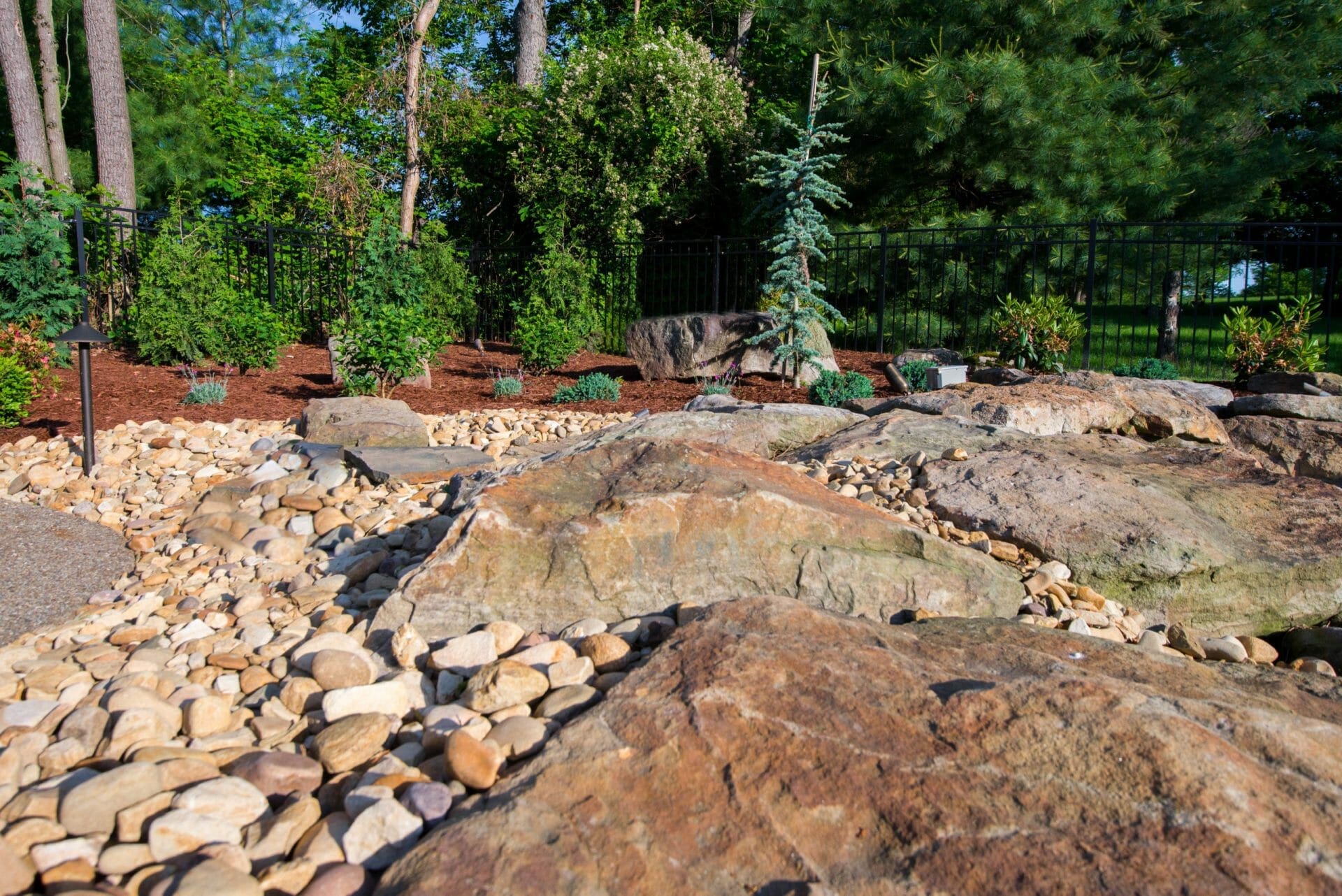 Boulderscapes exist on a spectrum. At one end is the true boulder feature: large individual stones, two to four tons or more, set deeply into the grade so they read as emergent from the earth rather than placed on top of it. These are the most dramatic and most permanent installations, and they require equipment and expertise to execute correctly.
In the middle of the spectrum are natural stone outcropping features: combinations of boulders and smaller stones arranged to simulate the kind of layered rock formations you'd find in western Pennsylvania's geology. These work particularly well on slopes and work naturally with native plantings tucked into the pockets between stones.
At the more accessible end of the range, rock gardens and mixed stone features incorporate smaller boulders and stone of various sizes with drought-tolerant and low-maintenance plantings. These are often installed in areas where conventional lawn or planting beds have failed, particularly on south-facing slopes that dry out quickly in summer.
All of these approaches share common requirements: proper siting based on the existing grade and drainage, stone selection that fits the scale and character of the property, and installation that sets each stone with intention rather than simply placing it on the surface.
Water Features: Form Follows Function
A recirculating water feature, whether a disappearing fountain, a pondless waterfall, a formal reflecting pool, or a naturalistic stream, is fundamentally a closed-loop water system. Water is stored in a reservoir, pumped through the feature, and returned to the reservoir to repeat the cycle. No municipal water connection is required after the initial fill. Water loss is limited to evaporation, which in Pittsburgh's climate is modest compared to warmer, drier regions.
Understanding the mechanics helps homeowners ask better questions when evaluating a water feature installation. The visible element, the waterfall face, the stream bed, the fountain head, represents a fraction of the total project. What determines whether the feature performs beautifully or becomes a maintenance headache is what's underneath: the reservoir sizing, the pump specification, the liner quality, and the drainage management around the feature.
Siting a Water Feature Correctly
Placement is the most consequential decision in a water feature installation, and it's the one most often made for the wrong reasons. Homeowners frequently want a water feature in the location where they'll be able to see it from the house or from the primary outdoor living area, which is a reasonable starting point. But a feature sited without regard for drainage, sun exposure, tree canopy, and existing grade will create ongoing problems regardless of how beautifully it's built.
Water features placed at the base of slopes receive runoff from above during heavy rain events. Without proper berming and drainage management around the feature, that runoff carries sediment into the reservoir, stresses the pump, and degrades water clarity. Penn State Extension's stormwater management resources note that unmanaged residential runoff is a primary driver of erosion and water quality degradation in suburban Pennsylvania watersheds. A well-sited water feature with proper drainage actually helps manage that runoff; a poorly sited one concentrates it.
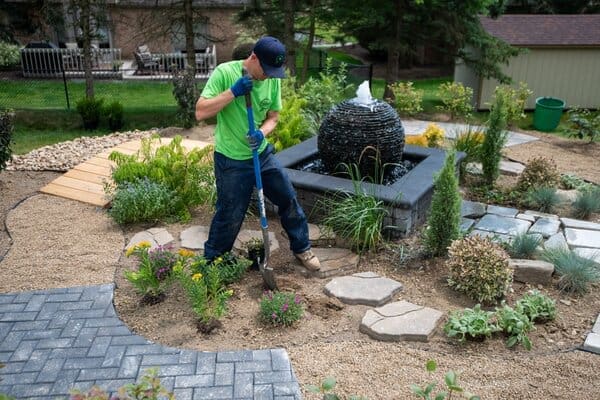 Sun exposure matters because of algae. A feature in full sun for most of the day will develop algae growth rapidly, requiring more frequent maintenance and water treatment. Some direct sun is fine and supports aquatic plantings if included in the design. Full shade creates its own challenges for water chemistry. The sweet spot for most South Hills installations is dappled or partial shade, which moderates algae while keeping the feature visible and visually connected to the surrounding garden.
Tree canopy proximity requires careful evaluation. The naturalistic look of a water feature set beneath mature trees is appealing, but leaf litter, seed pods, and other organic debris degrade water quality rapidly, clog pump intakes, and create a maintenance burden that many homeowners underestimate at installation. Features near deciduous trees typically require seasonal pump removal and thorough cleanouts in fall.
Pondless Water Features: The Most Practical Choice for Most South Hills Properties
For the majority of residential South Hills properties, a pondless or disappearing water feature, where the water reservoir is buried below grade and covered with stone, offers the best combination of visual impact, low maintenance, and safety. There is no open pond, which eliminates the child safety concerns associated with traditional water gardens. The reservoir is self-contained, reducing debris accumulation. The sound and movement of water is present without the ongoing management that an open water garden requires.
Pondless waterfalls and stream features can be scaled from very modest (a small feature providing ambient sound on a patio) to quite large (a 20-foot cascading stream as a landscape centerpiece). The design principles governing drainage, pump sizing, and stone placement are the same at any scale.
Winterization: The Piece Most Homeowners Don't Think About in July
Water features in Pittsburgh's Zone 6b climate require winterization before freeze-up, typically by late October or early November depending on the season. Recirculating pumps left running in freezing temperatures can be damaged by ice formation in the lines. Submersible pumps should be removed from the reservoir, cleaned, and stored indoors for winter. Above-grade plumbing should be drained.
Penn State Extension's pond management resources provide useful guidance on seasonal water feature and pond maintenance in Pennsylvania's climate. The principles for residential recirculating features are similar: the goal is to eliminate standing water in any component that could freeze and expand, causing damage to pumps, fittings, or liner.
This is worth knowing in July because it affects feature design. Features designed with winterization in mind, with accessible pump chambers, drain points in the appropriate locations, and reservoir access that doesn't require dismantling the stone surface, are significantly easier to maintain through Pittsburgh winters than features where winterization was an afterthought.
Why These Features Belong in a Designed Landscape, Not a DIY Project
More than almost any other landscape feature, boulderscapes and water features are frequently attempted as DIY projects and frequently fail as DIY projects. The reasons are predictable. Large stone is unforgiving to set incorrectly: a boulder placed without adequate burial depth and proper bedding looks placed, not emergent, and once set, correcting it requires equipment. Water feature components sold at home improvement stores are typically sized for modest, flat installations, not for the grades and drainage volumes common on South Hills properties.
The design work matters here in a way it doesn't for simpler landscape elements. A well-designed boulderscape reads as natural. A poorly designed one, regardless of the quality of materials used, looks like an obstacle. Getting to natural-looking requires someone who understands stone composition, scale relationships, how stone sits in the ground, and how to select pieces that work together rather than simply filling a space.
Planning Now for a Summer or Fall Installation
Boulderscape and water feature projects are among the most scheduling-dependent in the landscape construction calendar. Large stone delivery and equipment access require coordination and lead time. Feature components, particularly quality liner and pump systems, have supply chain variability. Projects that begin with a design conversation in July can realistically be installed in late summer or early fall. Projects that begin in September are typically looking at the following year.
Dream Greener's landscape construction team designs and installs boulderscapes, natural stone features, rock gardens, and recirculating water features across the South Hills. We assess each site for grade, drainage, sun exposure, and character before recommending an approach, and we carry our own natural stone and material inventory, which reduces the lead time and supply uncertainty that can push projects off schedule. Our process starts with a 15-minute consultation call followed by an on-site Dream Meeting where we walk your property, evaluate the challenges and opportunities, and develop a proposal specific to your site and your goals.
Frequently Asked Questions About Boulderscapes and Water Features in Pittsburgh
What is a boulderscape and how is it different from a rock garden?
A boulderscape typically refers to a feature that uses large-scale stone, often individual boulders weighing one to four tons or more, as the primary design element. A rock garden more commonly uses smaller stone in combination with drought-tolerant plantings. In practice, many South Hills installations blend both approaches: large anchor stones with smaller outcropping material and plantings integrated throughout. The distinction matters less than the design approach, which in both cases should make the stone look like it belongs to the land rather than sitting on top of it.
How do I know if a water feature will work on my property?
The key site factors are grade (a feature needs somewhere for water to fall or flow), drainage management (the surrounding area needs to handle runoff without delivering it into the reservoir), sun exposure, and access for equipment during installation. A flat, heavily shaded, tree-root-dense backyard creates challenges that a skilled designer can often navigate but that a DIY installation will struggle with. The most reliable starting point is a site assessment from a landscape professional who can evaluate your specific conditions before committing to a design direction.
Are water features high maintenance?
A well-designed and properly built pondless water feature requires modest ongoing maintenance: periodic debris removal from the reservoir and pump intake, seasonal pump removal and storage for winter, and occasional water treatment if algae becomes an issue. Features near heavy deciduous tree canopy require more attention, particularly in fall. An open water garden with aquatic plantings and fish requires considerably more ongoing management. Most homeowners who choose a pondless recirculating feature find the maintenance burden comparable to other landscape elements.
What does it cost to install a water feature in Pittsburgh?
Water feature costs vary considerably based on scale, complexity, and site conditions. A modest pondless fountain feature suitable for a patio or small garden area starts at a few thousand dollars installed. A larger naturalistic stream or waterfall feature with significant stone work and professional-grade pump components runs considerably higher. Site-specific factors, including grade changes, drainage requirements, and access for equipment and stone delivery, affect cost significantly. An accurate estimate requires a site visit and design conversation.
Can boulderscapes solve erosion problems?
Yes, and this is one of the most practical applications for natural stone landscaping in the South Hills. Properly set boulders anchor slopes, slow surface water flow, and create stable planting pockets that vegetation alone cannot provide on steep grades. Unlike retaining walls, which hold soil back through structural force, a well-designed boulderscape integrates with the grade and manages water movement more naturally. On slopes too steep for lawn maintenance or too erosion-prone for plantings alone, a boulderscape is often the most durable and lowest-maintenance long-term solution.
How are large boulders delivered and set on a residential property?
Large stone delivery and placement requires equipment access: a delivery truck capable of handling the stone weight and a skid steer or small excavator for placement. This is one of the key practical considerations in siting a boulderscape. Properties with limited access due to fencing, gates, or narrow side yards may restrict what stone sizes are practical. Dream Greener evaluates access as part of the initial site assessment and designs around realistic delivery and equipment constraints rather than proposing features that can't be installed on your specific property.