Homeowners ask us about lime almost as often as they ask about fertilizer, and the two get mixed up a lot. Fertilizer feeds grass. Lime doesn’t feed anything. What it does is change the soil so the grass can actually use the food that’s already there and the fertilizer you put down. On a lawn whose soil has drifted too acidic, that can be the difference between a program that works and one that seems to do nothing.
Here’s what lime does, how to tell whether your lawn needs it, and when it goes down in Pittsburgh.
What Does Lime Actually Do for Grass?
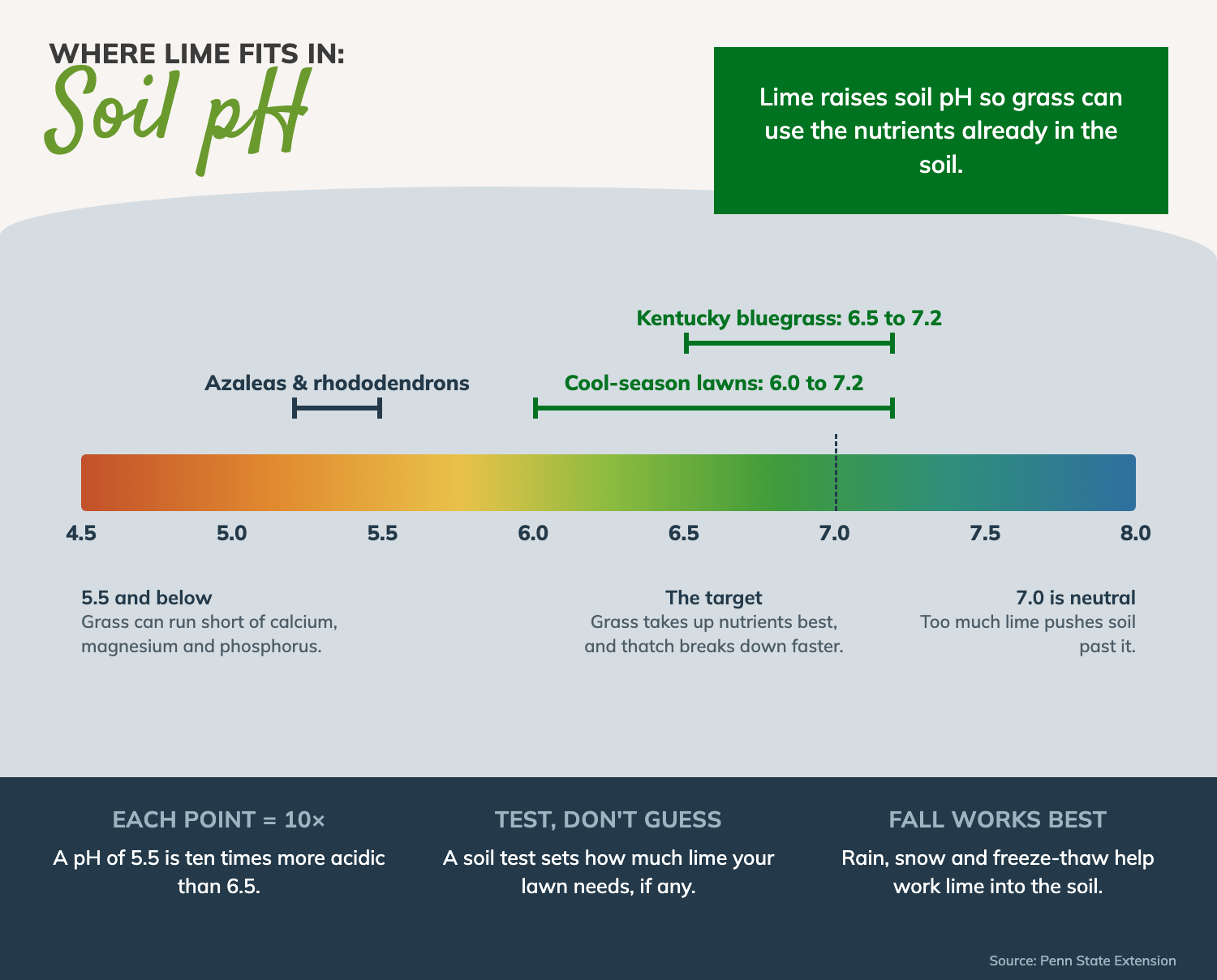
Lime is ground limestone, and its job is to raise soil pH, which means making acidic soil less acidic. That matters because pH controls how much of the soil’s nutrients grass can reach. According to Penn State Extension’s guide to liming turfgrass, cool-season lawns grow best between a pH of 6.0 and 7.2, and Kentucky bluegrass, the most widely planted lawn grass in Pennsylvania, does best between 6.5 and 7.2. Once soil drops to 5.5 or below, grass can run short of calcium, magnesium and phosphorus even when they’re present. The scale is steeper than it looks, too: every full point is a tenfold change, so a soil at 5.5 is ten times more acidic than one at 6.5. Keeping pH in range also helps the soil’s microbes break down thatch.
How Do You Know If Your Lawn Needs Lime?
A soil test is the only reliable way. Penn State is blunt about it: apply limestone only if a test shows a need, and never guess at the amount. Home kits can give a rough pH reading, but they can’t tell you how much lime to use, which is the number that matters. There are clues worth noticing first. Lawns lean acidic over time on their own, and regular nitrogen fertilizer speeds that up, according to Penn State’s guide to soil acidity. Plantain, red sorrel and knotweed are among the indicator weeds Penn State links to acidic soil, and thin turf that doesn’t respond to fertilizer is another sign. For our lawn care clients, soil testing is an option we recommend before any lime goes down.
Does Lime Kill Weeds or Moss?
No, and it’s one of the most common misunderstandings about it. Lime isn’t a weed control. Penn State’s turf guidance says it directly: weeds can’t be controlled with lime, but keeping soil from becoming too acidic is one way to prevent severe weed problems from developing. Moss is a good example. It’s more common in acidic soil, so correcting pH helps grass compete with it, but moss also thrives in shade and in wet, poorly drained ground, and lime won’t fix either of those. If weeds are the main problem, our post on controlling weeds in Pittsburgh lawns is the better starting point.
When Is the Best Time to Lime a Lawn in Pittsburgh?
Fall, if you have the choice. Penn State notes that ground limestone can go down any time of year but works best in fall, because rain, snow and winter freeze-thaw cycles help work it into the soil. That’s a rare case where a Pittsburgh winter does your lawn a favor. Spring applications work too, just more slowly. We apply lime in spring or fall, based on what the soil test shows. Fall liming also pairs naturally with core aeration, since the holes give it a direct path into the root zone. Our post on compost topdressing after fall aeration covers that pairing in more detail.
How Much Lime Does a Lawn Need, and How Fast Does It Work?
The soil test sets the amount, and the answer varies a lot from yard to yard, even between neighbors in Cecil or South Fayette. When a lawn needs a lot, it goes down in stages: Penn State advises no more than 100 pounds per 1,000 square feet on an established lawn in a single application, splitting the rest between spring and fall. Don’t expect an overnight change, either. Even finely ground lime takes several months to react with the soil, so think of it as a correction you see over a season, not a week. One local caution: keep lime out of the beds around azaleas, rhododendrons and blueberries. They prefer acidic soil, and they’re in a lot of South Hills foundation plantings, right next to the lawn.
Frequently Asked Questions About Lime for Pittsburgh Lawns
What does lime do for your lawn?
Lime raises soil pH, making acidic soil less acidic. That lets grass take up the nutrients already in the soil and get more from its fertilizer. Lime isn’t a fertilizer itself, and it doesn’t feed the grass directly.
Can you put down too much lime?
Yes. Too much can push soil too far toward alkaline, where some nutrients become harder for grass to use. That’s why Penn State Extension advises applying limestone only when a soil test shows a need, and never guessing at the amount.
Is it better to lime in spring or fall?
Fall is usually better. Rain, snow and the freeze-thaw cycles of a Pittsburgh winter help work lime into the soil. Spring applications are fine when a soil test calls for one, and lawns that need a lot of lime often get it split between both seasons.
How long does lime take to work?
Months, not days. Even finely ground lime needs several months to react with the soil, so the effect builds over a season. Retesting the soil later shows how far the pH has moved.
Does Dream Greener apply lime?
Yes. Lime application is an add-on to our lawn care, applied in spring or fall based on your soil test. Soil testing is an option we recommend first, so we add only what your soil actually needs.