Many of the pruning problems we see across the South Hills don’t come from bad cuts. They come from good cuts made at the wrong time of year. A lilac sheared in October, a hydrangea cut back in May, a maple trimmed right as it leafs out. Each one looked like routine yard care when it happened, and each one cost the plant a season of flowers or growth. Pruning well comes down to two things: knowing when each plant wants to be cut, and knowing how to make the cut so it closes cleanly.
This guide covers both, for the trees and shrubs we work on most in Pittsburgh yards.
Why Does Pruning Timing Matter So Much?
Because plants set up their flowers and their growth on different schedules, and pruning at the wrong point undoes that work. Spring-blooming shrubs form next year’s flower buds the summer before, so the buds sit on the branches all winter. Summer-blooming shrubs flower on growth they haven’t made yet. Trees, meanwhile, recover best from pruning when the cut is made before the spring growth flush. The International Society of Arboriculture notes that growth and wound closure are strongest when pruning happens before that flush, and that heavy pruning of live wood just after it should be avoided. The same pair of loppers can help or hurt a plant depending on the month.
When Should You Prune Flowering Shrubs?
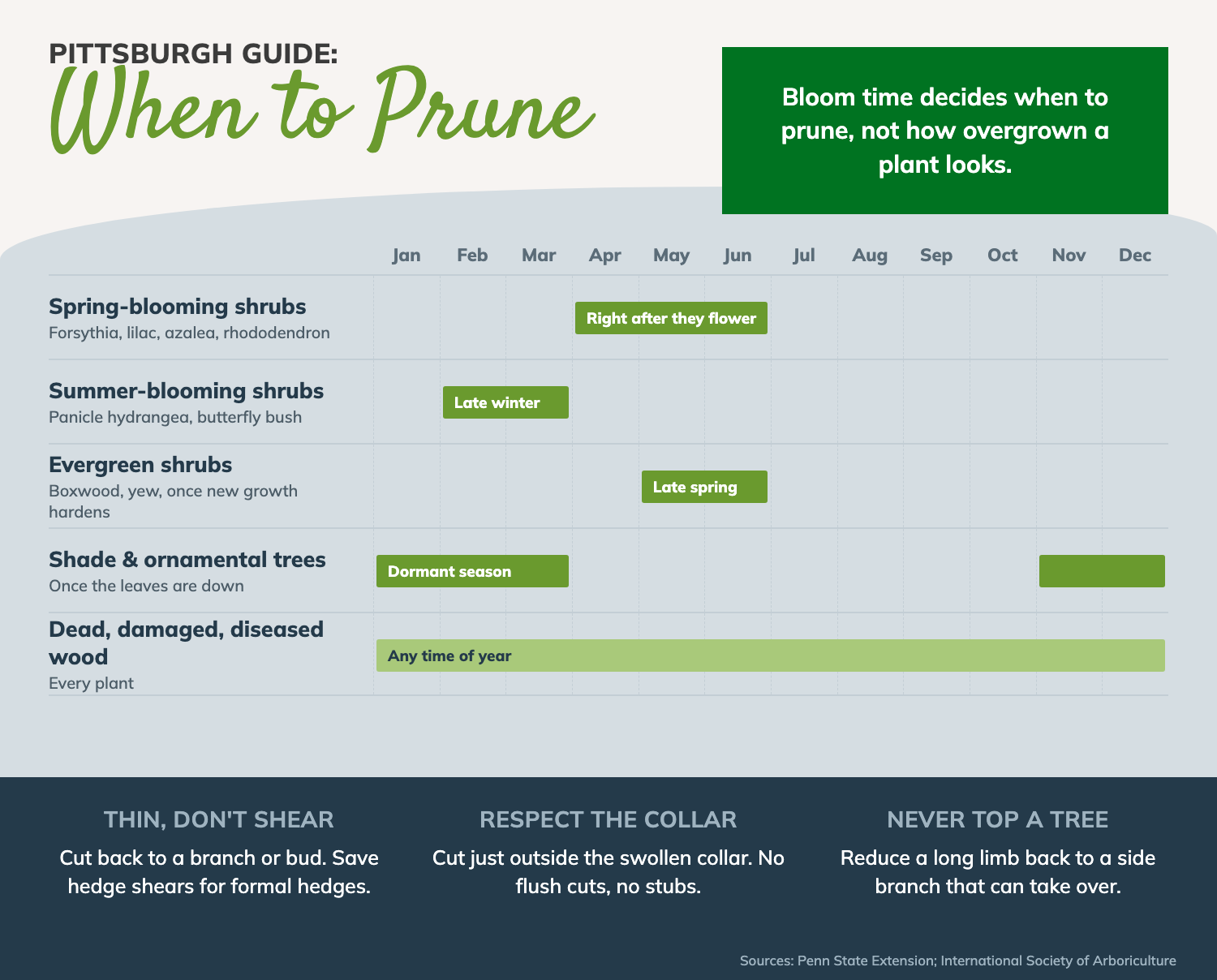
Sort them by bloom time first. Spring bloomers, including forsythia, lilac, azalea, rhododendron, viburnum and spring spirea, should be pruned right after they finish flowering. Wait much longer and you start removing the buds for next year, which is the mistake behind many of the “it barely bloomed this spring” calls we get, and the subject of our post on fall pruning mistakes. Summer bloomers flower on new wood, so they’re pruned in late winter or very early spring, before they leaf out. That group includes panicle and smooth hydrangeas, butterfly bush, summersweet and repeat-blooming roses. Penn State Extension’s guide to pruning flowering shrubs lists more varieties in each group. Bigleaf hydrangeas are the common exception in local yards: they bloom on last year’s wood, so treat them like a spring bloomer.
When Is the Best Time to Prune Trees and Evergreens?
For most shade and ornamental trees, the dormant season, from late fall through late winter, is the strongest window. With the leaves down, crossing limbs and weak branch unions are easy to see, and the tree has the whole spring to close its cuts. Oaks need the strictest timing, since fresh wounds can let in oak wilt; our post on winter tree pruning in Pittsburgh explains why we keep oak work to December through February. Maples and birches may drip sap from late-winter cuts, which looks alarming but doesn’t harm the tree. Evergreen shrubs such as boxwood and yew are different again: they’re best shaped in late spring, once the new growth has hardened off.
How Do You Make a Good Pruning Cut?
Cut a branch back to where it starts, or to a bud or side branch, rather than leaving a stub. On larger limbs, cut just outside the branch collar, the slightly swollen ring where a branch meets the trunk. That collar is where the tree seals the wound, so a flush cut that removes it leaves the trunk open to decay, and a long stub dies back instead of closing. Shearing is fine for a formal hedge, but Penn State points out that very few shrubs adapt well to it, and even sheared hedges should be thinned from the inside now and then so they don’t go bare in the middle. On trees, never top. Reducing a long limb back to a side branch big enough to take over keeps the tree’s shape and strength; topping does neither.
How Do You Bring Back an Overgrown Shrub?
With patience, and usually over three years. Suckering shrubs like forsythia and lilac renew themselves when the oldest, thickest stems are removed at ground level. On a badly overgrown shrub, Penn State recommends taking out about a third of the old stems each year until the plant has been rebuilt from younger wood, and doing hard pruning in early spring before the leaves come out. It’s slower than cutting the whole shrub to a stump, but the plant keeps flowering and filling in while you work. It’s a good fit for the overgrown foundation plantings common on older homes in Mt. Lebanon and Bethel Park.
When Should You Call a Professional?
Hand pruners and loppers handle most shrub work. Anything that needs a ladder and a saw, any limb hanging over the house or driveway, and anything near a power line is a different job, and line work belongs to the utility. Our crews handle shrub and ornamental tree trimming, on trees and shrubs up to 25 feet, on its own or as part of a landscape maintenance plan, and we identify each plant’s timing during a Lawn & Landscape Analysis. If a tree’s health is the concern rather than its shape, our Tree & Plant Health Care program is the place to start.
Schedule Your Lawn & Landscape Analysis
Frequently Asked Questions About Pruning Trees and Shrubs in Pittsburgh
What month should I prune shrubs in Pittsburgh?
It depends on when the shrub blooms. Spring bloomers like forsythia, lilac and rhododendron are pruned right after they flower, usually April through June. Summer bloomers like panicle hydrangea and butterfly bush are pruned in late winter, around February and March. Evergreens like boxwood and yew are shaped in late spring once new growth hardens.
Can I prune in the fall?
Dead, damaged or diseased wood can come off any time of year. Hold off on shaping spring-blooming shrubs, since fall pruning removes the flower buds they’ve already set for next spring. Most trees are better pruned once they’re fully dormant in late fall and winter.
How much of a shrub can I cut back at once?
For an overgrown shrub, Penn State Extension recommends removing about one-third of the oldest stems each year over three years, rather than cutting it all back at once. Routine maintenance pruning takes much less than that.
Is topping a tree ever a good idea?
No. Topping leaves a tree with large wounds and weakly attached regrowth. The International Society of Arboriculture recommends reduction instead: cutting a long limb back to a side branch large enough to take over its role, which keeps the tree’s natural form and structure.
Does Dream Greener prune shrubs and small trees?
Yes. Our crews trim shrubs and ornamental trees up to 25 feet, on their own or as part of a landscape maintenance plan. During a Lawn & Landscape Analysis we identify which of your plants need pruning and when.